What the package does
- Load CF/Radial-style MRR-PRO NetCDF files into an
MRRProDataobject. - Run the RaProMPro processing workflow or load previously generated products.
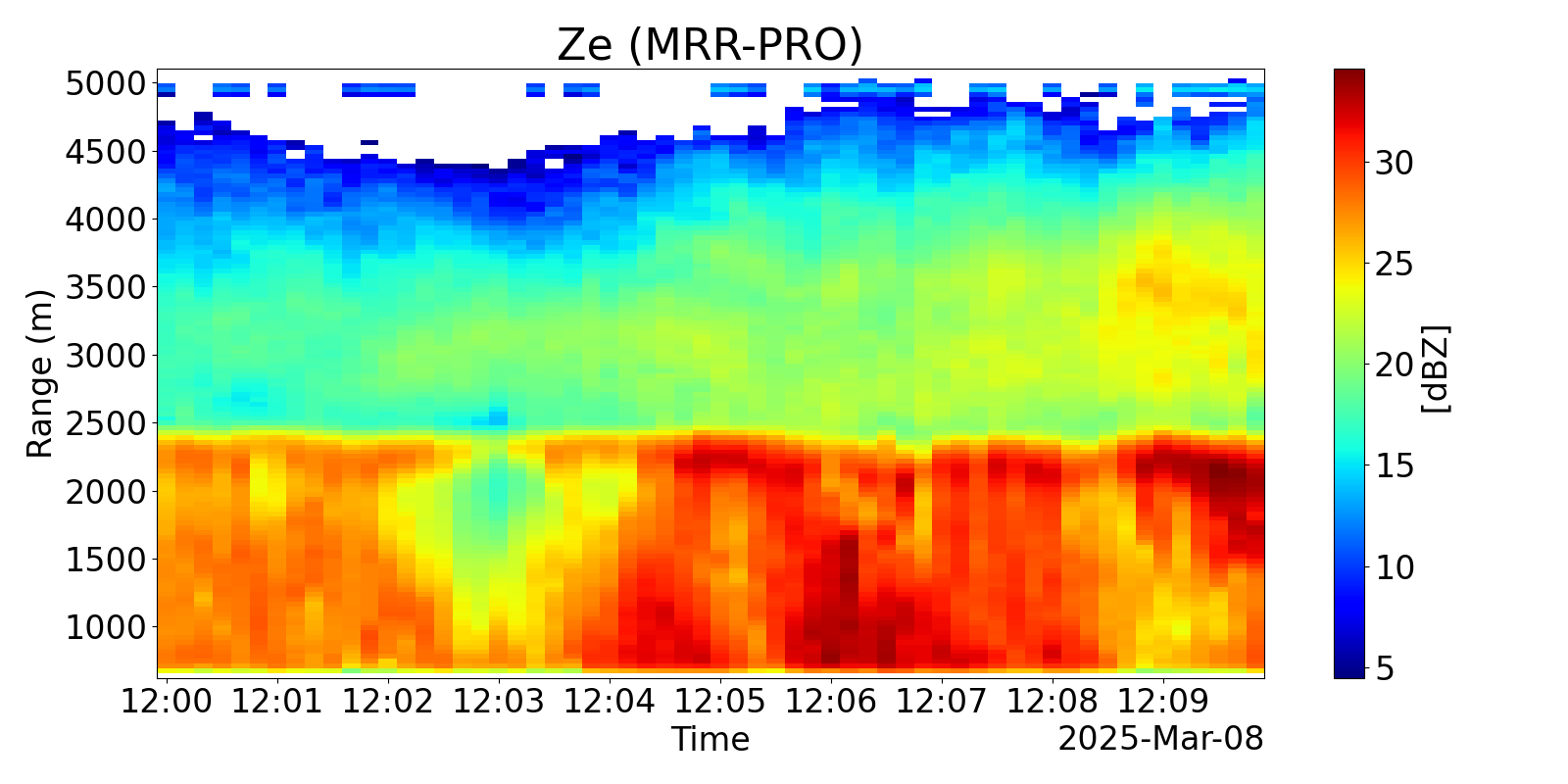
- Plot reflectivity quicklooks, spectra, spectrograms, DSD views and profile diagnostics.
- Analyse layer-scale rain-process signatures from
Dm,NwandLWC. - Classify process evolution on the RGB hexagram using non-parametric trend diagnostics by default.
Quick start
The public API is centered on mrrpropy.raw_class.MRRProData.
A typical workflow is to open a raw file, load or compute the processed
product, and plot one diagnostic field.
from pathlib import Path

from mrrpropy.raw_class import MRRProData

raw_path = Path("tests/data/RAW/mrrpro81/2025/03/08/20250308_120000_10min.nc")
processed_path = Path("tests/data/PRODUCTS/mrrpro81/2025/03/08/20250308_120000_10min_raprompro.nc")

mrr = MRRProData.from_file(raw_path)

# Fast path if a generated processed product already exists locally
mrr.load_raprompro(processed_path)

# Alternatively, generate a processed dataset into PRODUCTS/
# mrr.process_raprompro(save=False)

fig, ax = mrr.quicklook(variable="Ze", source="raprompro", vmin=0, vmax=40)Processing workflow
The package keeps the scientific RaProMPro implementation available while exposing a higher-level, xarray-based interface for processing, diagnostics, and robust microphysical trend analysis. Public velocity outputs and plots use negative values for downward hydrometeor motion.
Examples
Examples cover reflectivity quicklooks, Doppler spectrum views and microphysical-process analysis using the current public API.
References
The documentation includes the core scientific references for the retained RaProMPro implementation used with METEK MRR-PRO data, together with the related MRR-2 methodology and the original upstream code repository.
Developer material
Contributor workflow, typing scope and documentation build details remain available, but they are secondary to the user-facing documentation.